



Punching Press Machine for Sale
10 ton J23-10T punching press machine for sale
Punching press machine price: 600 USD FOB China
A punching press machine is a metalworking press that cuts holes, blanks outlines and notches corners in sheet metal by driving a punch through a die in one vertical stroke. This 10 ton J23-10T is the smallest punching press machine we build for production work: 98 kN of force, a 50 mm stroke, 140 strokes per minute and a 1.1 kW motor, and it sells for 600 USD FOB China in standard configuration.
It is the size a small workshop buys when the work is brackets, contacts, washers, terminal lugs, small covers, press buttons and hardware parts in sheet up to about 1.5 mm, and the volume is too high for a hand press but too low to justify a 25 or 40 ton frame. On this page: what it can punch, the full J23-10T specification, the parts and clutch that make it work, the types of presses we supply, die selection, guarding, maintenance, the price breakdown, and how to buy from a Chinese factory without surprises.

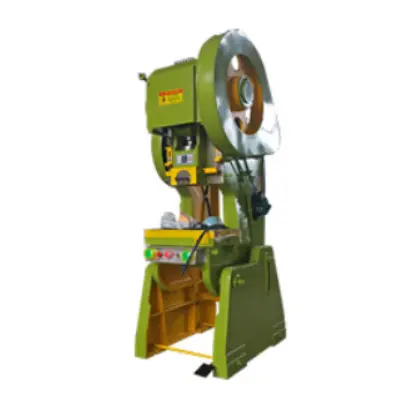
Left: the J23-10T, 10 ton, 1.1 kW. Right: the same frame with the flywheel guard, push-button station and foot pedal fitted for delivery.
1. What a 10 ton punching press machine can punch
At 10 tons nominal, planning at 80 percent gives 78.5 kN of usable force. In 1 mm mild steel that is 224 mm of cutting perimeter — a Ø71 mm round hole, a 56 × 56 mm square, or a 100 × 12 mm slot. In 2 mm mild steel the same force cuts 112 mm of perimeter, which is a Ø36 mm hole or a 28 × 28 mm square. That covers the small-part work this class of press is built for.
We size every job with the standard formula, so neither the press nor the die is overloaded:
Force (kN) = perimeter (mm) × thickness (mm) × shear strength (N/mm²) ÷ 1000. Mild steel ≈ 350 N/mm², stainless ≈ 500 N/mm², aluminium ≈ 200 N/mm².
Capacity by material thickness
| Material thickness | Max cutting perimeter at 10 t (80% rule), mild steel | Typical shape it allows |
|---|---|---|
| 0.5 mm | 448 mm | Ø142 mm round, or a 112 × 112 mm square |
| 0.8 mm | 280 mm | Ø89 mm round, or a 70 × 70 mm square |
| 1.0 mm | 224 mm | Ø71 mm round, or a 56 × 56 mm square |
| 1.5 mm | 149 mm | Ø48 mm round, or a 37 × 37 mm square |
| 2.0 mm | 112 mm | Ø36 mm round, or a 28 × 28 mm square |
| 2.5 mm | 90 mm | Ø29 mm round, or a 22 × 22 mm square |
| 3.0 mm | 75 mm | Ø24 mm round, or a 19 × 19 mm square |
| 4.0 mm | 56 mm | Ø18 mm round, or a 14 × 14 mm square |
Stainless steel cuts roughly 30 percent less perimeter at the same thickness because its shear strength is higher, and aluminium roughly 75 percent more. A 1 mm stainless part is limited to about 157 mm of perimeter on this press, so a Ø50 mm hole in 1 mm stainless is already at the limit of the frame and belongs on a 25 ton press instead.
Output per hour
140 strokes per minute sounds like 8,400 parts an hour, but real output is lower. Allow for loading, part removal and the reaction time of the operator: at 70 percent efficiency the press delivers about 5,880 strokes per hour on a single-stroke cycle, and around 3,000 to 4,000 parts per hour on hand-fed work with a simple stop gauge.
2. J23-10T punching press machine specification
The J23-10T is an open, tiltable C-frame press with a horizontal crankshaft and an external gear train. The table below is the standard build we ship; stroke, throat depth, bolster size and voltage can be changed on request, and every press is run with a die before it is packed.
| Parameter | Value | What it means on the shop floor |
|---|---|---|
| Nominal force | 10 ton (98 kN) | Maximum pressing force at the bottom of the stroke |
| Nominal stroke | 50 mm | Slide travel; enough for blanking and shallow forming |
| Strokes per minute | 140 | Continuous speed with the motor at full load |
| Die height adjustment | 40 mm | Shim-free die setting within this range |
| Bolster (table) size | 350 × 220 mm | Largest die shoe that sits fully supported |
| Throat depth | 120 mm | Distance from frame to slide centre; limits part width |
| Blanking hole | Ø95 mm | Scrap and small parts fall through the table |
| Outline dimension | 800 × 600 × 1500 mm | Floor space and door height for container loading |
| Main motor | 1.1 kW | Runs on 220 V or 380 V three-phase, 50 or 60 Hz |
| Net weight | 300 kg | Forklift or pallet truck; no foundation needed |
At 300 kg the press does not need a concrete foundation. It sits on a level floor on anti-vibration pads, which is why it is also the model we ship to repair shops, vocational schools and job shops that rent their building.
3. Why this power press punching machine sells
Five design points decide whether a small power press punching machine survives ten years of daily work or shakes itself apart in two. These are the ones we do not compromise on:
- Cast frame, not welded plate. The C-frame is cast iron, which absorbs vibration instead of transmitting it. A welded frame is cheaper to make and rings under load; the casting is why the die lasts longer on this press.
- Horizontal crankshaft, external gears. The crankshaft sits horizontally with the gear train outside the frame, so you can inspect tooth wear and re-grease without stripping the press. Maintenance that needs a crane does not get done.
- Collapse-type overload protection. A shear fuse sits in the drive. If the slide is overloaded — a double blank, a mis-set die — the fuse collapses and stops the press before the frame or the die is damaged. A new fuse costs a few dollars; a new crankshaft does not.
- Push button and foot pedal. Both controls are standard: the button station for single strokes, the pedal for continuous work with both hands free to feed. That is what makes a 10 ton press productive on small parts.
- Ready for automatic feeding. The slide and the control circuit accept a roll feeder, a vibratory bowl or a pneumatic gripper, so the same press can start as a manual press and be automated later without replacing the frame.
One more point that matters in tender documents: the press is built to the J23 series dimensional standard, so standard die sets, die shoes and bolster plates for a 10 ton J23 fit without modification.
4. Parts of a punching press machine
The machine has six working groups: the frame, the drive (motor, flywheel, clutch), the crankshaft and connecting rod, the slide, the bolster and the control circuit. Every one of them is accessible from the front or the side on this open-frame design, which is the practical difference between a press you can service and one you cannot.
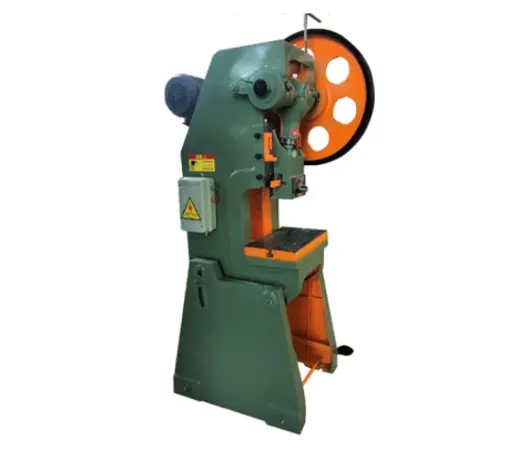
- Frame. Cast C-frame, tiltable on the base so blanks and scrap slide out of the die towards the operator or into a bin.
- Flywheel. Stores the energy of the motor over a full revolution and releases it in the short working part of the stroke — that is how a 1.1 kW motor delivers 98 kN.
- Clutch. Connects the flywheel to the crankshaft on demand. On this size of press it is a rigid or rolling-key clutch, engaged by the button or the pedal and released by the brake at the top of the stroke.
- Crankshaft and connecting rod. Convert rotation into the straight-line stroke of the slide.
- Slide and ram adjustment. Carries the punch; the die height adjustment screw sets shut height within 40 mm.
- Bolster and die cushion. The table the lower die sits on, with the Ø95 mm blanking hole through the middle.
- Control circuit. Push-button station, foot pedal, and the interlock that stops the press if the guard is open.
5. Types of punching press machines we build
These machines are classified by drive, not by tonnage. Mechanical, hydraulic, pneumatic, hand, desktop, panel and press button machines do different jobs, and buying the wrong type is more expensive than buying the wrong tonnage.
| Type | Drive | Tonnage we build | Best for | Limit to know |
|---|---|---|---|---|
| Mechanical power press (J23) | Flywheel + clutch | 10 to 200 t | Blanking, piercing, notching, shallow forming | Full force only near the bottom of the stroke |
| Hydraulic punching press machine | Oil pump and cylinder | 10 to 500 t | Deep drawing, long strokes, constant force | Slower cycle, higher price per ton |
| Pneumatic punching press machine | Air cylinder | 1 to 20 t | Light piercing, delicate parts, clean rooms | Needs a compressed air line; low force |
| Hand press punching machine | Lever, rack or screw | 0.5 to 2 t | Prototypes, repair work, no power supply | Operator fatigue; one part at a time |
| Desktop punching press machine | Small mechanical or toggle | 1 to 5 t | Bench work, small hardware, training | Limited die space and throat |
| Panel punching press machine | Mechanical or CNC turret | 30 to 300 t | Switchboards, enclosures, control panels | Needs a large table and gauging |
| Press button punching machine | Small mechanical | 1 to 5 t | Snap fasteners, eyelets, buttons, rivets | Dedicated tooling per button size |
Mechanical or hydraulic?
Mechanical wins on speed and price per ton; hydraulic wins on stroke and drawing depth. For a press doing holes and blanks in sheet up to 3 mm, mechanical is the correct answer at any tonnage from 10 to 200 t. Move to hydraulic when the part is drawn deeper than about half its diameter, or when you need the slide to hold pressure at any point in the stroke.
When a hand press or desktop press is enough
If the annual volume is under a few thousand parts, or the work is repair and prototype, a hand press punching machine costs a fraction of a motorised press and needs no electrical installation. The desktop model sits between the two: a small motorised unit for bench work on hardware, eyelets and small brackets. Both are in our catalogue, and we will say so when a 10 ton powered press is more machine than the job needs.
Large frames: 200 ton and the JH21 series
At the top of the range we build the 200 ton pneumatic hole punch press punching machine in the JH21 series — an open fixed-table press with a pneumatic clutch and brake, wet or dry, used for thick plate, truck frames and heavy brackets. It shares the same die-setting logic as the 10 ton press on this page, which is why a customer who starts with a J23-10T can scale up without relearning the tooling.
6. Dies and die sets for a 10 ton press
A die set is a matched punch and die in a guided frame; on a 10 ton press the die set costs 20 to 40 percent of the whole project, so it deserves as much attention as the press. Four types cover almost every job in this tonnage class:
- Blanking die. Cuts the full outline of the part. The most common die on a small press, and the one that uses the full tonnage.
- Piercing die. Cuts holes only, leaving the blank attached to the strip. Cheaper than blanking because the scrap is small.
- Compound die. Blanks and pierces in the same stroke, so hole-to-edge tolerance is set by the die, not by the press. Worth the extra cost on parts with tight concentricity.
- Progressive die. Several stations, one strip, one stroke per station. Needs a roll feeder and a straightener, and only pays back above roughly 50,000 parts a year.
Two rules keep a 10 ton press out of trouble with tooling. First, keep the die height inside the 40 mm adjustment range so the shut height is set by the screw, not by shims. Second, keep the die shoe inside the 350 × 220 mm bolster — an overhanging shoe bends the table and misaligns the punch within a few thousand strokes.
7. Guarding and safe operation
A punching press machine is the most dangerous machine in a small metal shop, and almost every serious injury happens on the hands, at the die, on a press without a guard. The minimum we ship, and the minimum you should accept:
- Fixed guard over the flywheel and gear train, interlocked so the motor cannot start with the cover off.
- Point-of-operation guard — a fixed barrier, an interlocked gate or a two-hand control, chosen by the die and the part, not by convenience.
- Two-hand control or a foot pedal with a guard. A bare pedal under an unguarded die is the classic amputation setup.
- Emergency stop within reach of the operator, and a lockout point for die changes.
- Die block or safety block for every die change: the slide is blocked mechanically before anyone puts a hand between the tools.
Operators must never reach into the die area, must use tweezers, pliers or a magnetic pick-up for small parts, and must never remove a guard to speed up a job. If your market requires CE marking, OSHA 1910.217 compliance or a local equivalent, tell us at the quotation stage — the guard package, the control circuit and the documentation change, and retrofitting after shipment costs far more than ordering it correctly.
8. Maintenance schedule
A 10 ton press needs about fifteen minutes of maintenance a week and one half-day a year. The schedule below is the one we put in the manual, and following it is the difference between a press that holds tolerance after five years and one that starts producing burrs.
| Interval | Task | Why it matters |
|---|---|---|
| Every shift | Check oil level, listen for abnormal noise, test the stop function | Catches a failing clutch or brake before it fails under load |
| Weekly | Grease the slide guides, the connecting rod big end and the crankshaft bearings | Dry guides wear oval and the slide starts to tilt |
| Weekly | Clean the bolster, the blanking hole and the die area | Scrap build-up changes shut height and breaks punches |
| Monthly | Check clutch and brake adjustment, bolt torque on the frame and the die clamps | Loose clamps move the die mid-stroke |
| Monthly | Inspect the shear fuse and keep two spares in stock | A collapsed fuse is a five-minute fix; a missing spare stops production |
| Every 6 months | Change the oil, check the V-belt tension and the flywheel guard interlock | Old oil loses film strength at 140 strokes per minute |
| Every 12 months | Measure slide parallelism and die height adjustment play; re-level the press | Parallelism drift is the first sign of guide wear |
9. Punching press machine price: what 600 USD includes
10 ton J23-10T punching press machine: 600 USD FOB China, standard configuration, packed for sea freight.
Included: press with 1.1 kW motor, push-button station, foot pedal, flywheel guard, one set of standard tooling wrenches, operation and maintenance manual, and export packing.
Not included: die set, automatic feeder, special voltage or frequency, CE guard package, sea freight, insurance and import duty at destination.
Price per ton falls as the frame gets bigger, because the motor, the controls and the packing cost roughly the same on every size. That is why the 10 ton and the 63 ton sit at 60 USD per ton while a 25 ton sits at 100 USD per ton — the small press and the large press are both efficient builds, and the middle of the range carries the most sheet-metal content per ton of force.
| Model | Tonnage | Price (USD, FOB China) | Typical buyer |
|---|---|---|---|
| J23-10T | 10 t | 600 | Small workshop, repair shop, start-up production |
| J23-16T | 16 t | 1,400 | Hardware, brackets, terminals in 2 mm sheet |
| J23-25T | 25 t | 2,500 | General job shop, appliance and electrical parts |
| J23-40T | 40 t | 3,500 | Automotive brackets, thicker blanks |
| J23-63T | 63 t | 3,800 | Sheet metal parts in 3 to 4 mm |
| J23-80T | 80 t | 7,500 | Heavier blanking, larger die sets |
| J23-100T | 100 t | 9,000 | Structural parts, thick plate piercing |
| J23-200T | 200 t | 12,000 | Truck frames, heavy brackets, JH21 series |
Prices are for the standard build, FOB Chongqing or Shanghai, and are indicative — confirm the current price and the shipping cost to your port before you budget. A container mix of two or three presses usually cuts the freight per unit by 30 to 50 percent compared with a single machine.
10. Manufacturer, supplier or factory: how to buy
Most buyers searching for a punching press machine supplier end up talking to a trading company without knowing it. That is not automatically bad — a good trading company handles consolidation and documentation well — but you should know which one you are dealing with, because it decides who answers when a part fails in year three.
Six questions separate a factory from a reseller, and any of them can be answered in one email:
- Ask for the factory address and a video call from the assembly line. A trading company will offer a catalogue instead.
- Ask which parts are cast in-house. The frame and the slide are the two parts that decide quality; a factory casts or machines them, a reseller buys them finished.
- Ask for the serial number range they shipped last year. A real manufacturer has a continuous number series; a reseller has gaps.
- Ask for two spare-parts prices — a shear fuse and a clutch lining. A factory quotes in hours; a reseller has to ask someone else.
- Ask for the test report of your specific machine, with the die and the material, not a generic brochure photo.
- Ask what happens if the press is damaged in transit. The answer tells you whether the packing is engineered or improvised.
We are a manufacturer: the frames are cast and machined for us in Chongqing, the presses are assembled, run and packed in our own workshop, and we ship 10 to 200 ton presses to Latin America, Africa and Southeast Asia. Wholesale orders and distributor pricing are available from three units, and OEM branding — your plate, your manual, your colour — from ten units.
11. Packing, shipping and after-sales service
A 10 ton press ships as one packed unit of about 350 kg gross, on a plywood pallet with the slide blocked, the flywheel locked and the control box wrapped. Three or four units fit in a 20 ft container; a mixed order with 25 and 40 ton presses usually fills a 40 ft high cube more economically.
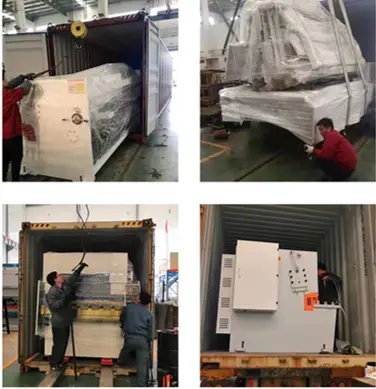
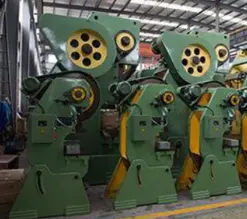
Left: blocking, wrapping and container loading. Right: presses assembled and run in our workshop before packing.
Shipping is FOB Chongqing or Shanghai, or CIF to your port if you prefer us to book the vessel. We work with a freight forwarder that handles the Latin American and African routes weekly, and we will quote both options so you can compare.
After-sales is where a small press order is usually abandoned, so here is what we actually provide: a manual in English and Spanish, a video of your machine running with the die before it is packed, spare parts at cost for five years, and remote support by WhatsApp or email with a response within one working day. Wear parts — shear fuses, clutch linings, brake bands, guide plates — are stocked and ship by courier within 48 hours. We do not send a technician for a 600 USD press; we send the part and stay on the phone until it runs.
12. Applications: hardware, electronics, appliances, panels
The 10 ton punching press machine is a small-part press. It is used where the part is light, the volume is steady and the tolerance is set by the die rather than by the frame.
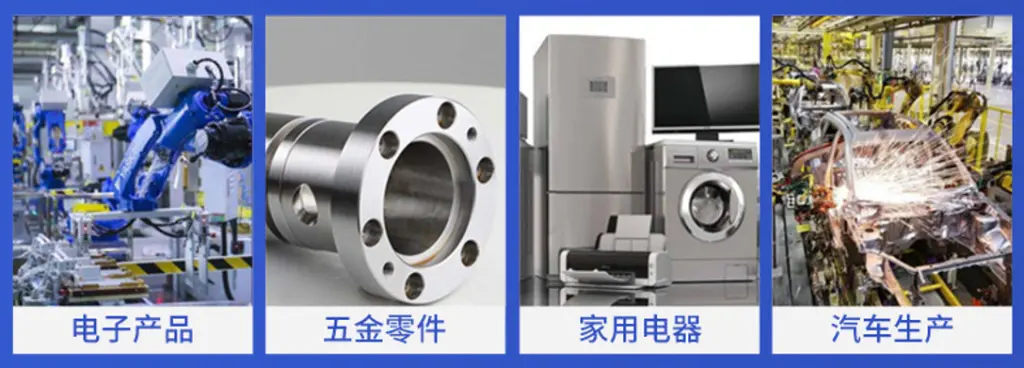
- Hardware and fasteners. Washers, brackets, hinges, corner plates, clips and small stampings in 0.5 to 2 mm steel.
- Electrical and electronic parts. Terminal lugs, contacts, plug pins, connector shells, computer case panels and chassis parts.
- Home appliances. Brackets, covers, motor mounts and decorative trim for appliances and small domestic machines.
- Press buttons and eyelets. Snap fasteners, eyelets, grommets and buttons for garments, bags, shoes and leather goods — a dedicated press button punching machine setup with the right die.
- Panels and enclosures. Knock-outs, cable entries and mounting holes in switchboard and control panels, where a panel punching press machine with a gauging table is the usual upgrade.
- Automotive and agricultural spares. Small brackets and clips for trailers, wheelbarrows and light machinery — the same parts our 40 and 60 ton presses make in thicker gauge.
What it will not do: draw a cup deeper than about 15 mm, blank a part wider than the 120 mm throat allows, or cut 6 mm plate. Those jobs need a 40 ton press or larger, and we will tell you so rather than sell you a machine that stalls at the first heavy part.
13. Glossary of punching press machine terms
These are the words that appear in a quotation, a die drawing or a customs document, with what they mean on a 10 ton press.
| Term | Meaning |
|---|---|
| Nominal force | Rated tonnage, measured at the bottom of the stroke — 10 ton, 98 kN on this press |
| Stroke | Slide travel, 50 mm here; longer strokes allow taller parts |
| SPM | Strokes per minute, 140 on this model |
| Shut height | Distance from bolster to slide with the stroke down — set by the die |
| Die height adjustment | Range over which shut height can be set without shims, 40 mm here |
| Throat depth | Clearance from frame to slide centre, 120 mm; limits how wide a part can be fed |
| Blanking hole | Hole through the bolster, Ø95 mm, for scrap and part drop-through |
| Shear fuse | Sacrificial overload element in the drive that collapses before the frame is damaged |
| Die set | Punch and die in a guided frame — the tooling, not the press |
| Press button die | Dedicated tooling for snap fasteners, eyelets and buttons |
| Torc-Pac clutch | A low-inertia clutch and brake unit used on larger mechanical presses for faster stopping |
14. Frequently asked questions
What can a 10 ton punching press machine cut in 1 mm steel?
About 224 mm of cutting perimeter at 80 percent of rated force — a Ø71 mm round hole, a 56 × 56 mm square, or a 100 × 12 mm slot. In 2 mm steel the same press cuts 112 mm of perimeter, roughly a Ø36 mm hole. Always check the perimeter of your part, not its area: tonnage follows the length of the cut.
Is 600 USD the final price of this punching press machine?
600 USD is the FOB China price for the standard 10 ton J23-10T with 1.1 kW motor, push-button station, foot pedal and flywheel guard. Die sets, automatic feeders, special voltage, CE guard packages, sea freight and import duty are additional. Ask for a CIF quote to your port to compare landed cost.
Do I need a foundation for a 300 kg press?
No. The 10 ton punching press machine sits on a level concrete floor on anti-vibration pads. Only presses from about 25 ton upwards, and any press running a heavy progressive die, need a bolted foundation.
Can this punching press machine run automatically?
Yes. The slide and control circuit accept a roll feeder, a vibratory bowl or a pneumatic gripper. Most customers start manually and add a feeder when volume grows, without changing the frame.
What is the difference between a punching press machine and a power press punching machine?
Nothing mechanical — they are two names for the same machine. "Power press" is the older British and Indian term, "punching press" is more common in export catalogues and search. Both describe a mechanical press that drives a punch through a die.
Which is better for a small shop, mechanical or hydraulic?
Mechanical, unless you are deep drawing. A mechanical punching press machine is faster, cheaper per ton and simpler to maintain. Hydraulic presses hold force through the whole stroke, which matters for drawing but is wasted on blanking and piercing.
How many parts per hour can I expect?
At 140 strokes per minute and 70 percent efficiency, about 5,880 strokes per hour on a continuous cycle. Hand-fed work with a stop gauge typically runs 3,000 to 4,000 parts per hour; a progressive die with a feeder gets closer to the machine limit.
What spare parts should I keep in stock?
Two shear fuses, one clutch lining, one brake band and a set of guide plates. These are the parts that stop production, they cost little, and they ship by courier within 48 hours.
Can you supply a hand press or desktop punching press machine instead?
Yes. For volumes under a few thousand parts a year, or for repair and prototype work, a hand press punching machine or a desktop punching press machine is the better buy and we will say so. Send us the part drawing and the annual volume and we will recommend the smallest machine that does the job.
Do you supply wholesale and OEM?
Yes. Distributor pricing starts at three units, OEM branding — nameplate, manual, colour — from ten units. Mixed containers with 16, 25 and 40 ton presses are common and reduce freight per machine by 30 to 50 percent.
Recommended Models
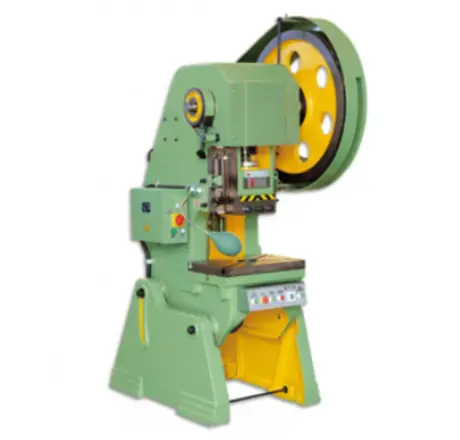


More machines
- Punch press machine: types, tonnage and buying guide
- 16 ton mechanical punch press: price, specs and capacity
- 25 ton punch press machine: the small workshop option
- 40 ton punch press machine for sale: price and capacity
- 63 ton sheet metal punch press machine (J23-63)
- 80 ton mechanical punch press machine: specs and price
- 100 ton mechanical punch press machine: specs and price
