



Punch Press Machine: Types, Tonnage and Buying Guide
A punch press machine is a metalworking press that cuts, pierces, notches, bends or forms sheet metal by driving a punch through a die with a mechanical, hydraulic or pneumatic ram. We build and export punch press machines from 5 ton to 200 ton, with 16 years of experience in metal punching, and this page explains how the machine works, how to size the tonnage, what the main parts and HS codes are, what a punch press machine costs and how to buy one from a Chinese factory without surprises.
Last updated: October 2026

Quick answer: for 1 to 3 mm mild steel sheet, a 25 to 40 ton mechanical punch press machine covers most job-shop work; for busbars, brackets and thick plate above 6 mm, choose a hydraulic punch press machine of 60 to 100 ton; for mixed small batches with many tool changes, a CNC turret punch press machine pays for itself through setup time.
● 1. Punch press machines we supply
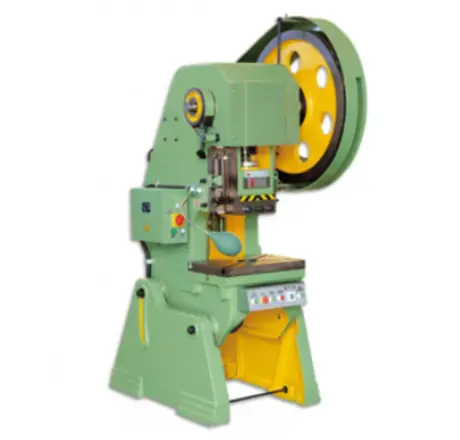
Standard models from 10 to 200 ton, mechanical and hydraulic, with throat depth, bolster size, stroke, speed and voltage built to your specification. Every machine is tested under load before shipment and shipped with the manual, hydraulic and electrical diagrams and a spare parts list. If you have already seen a Chinese model designation such as JB23-25 (25 ton open C-frame mechanical press) or JH21-63 (63 ton press with pneumatic clutch), tell us: we build to the same envelope and quote against that code.



● 2. What is a punch press machine and what does it do?
A punch press machine converts rotary motor power into a straight-line ram stroke that pushes a punch into a die. The die set defines the shape; the press only supplies force and stroke. That is why the same press can produce washers, brackets, louvers or number plates simply by changing the tooling.
The main operations performed on a machine punch press are punching (round and shaped holes), piercing, notching, slotting, blanking, perforating, bending, embossing, flanging, lancing and shallow drawing. The workpiece is usually cold-rolled steel, galvanized steel, stainless steel, aluminium, copper, brass or zinc sheet from 0.3 mm to 12 mm thick.
Who uses a punch press machine
Sheet metal fabricators, electrical panel builders, HVAC duct workshops, automotive tier-2 suppliers, signage and number plate shops, jewellery and sequin manufacturers, filter and mesh producers, and any workshop that needs thousands of identical holes rather than one accurate cut. Compared with laser cutting, a press punch machine wins on cost per hole, cycle time and edge quality on thin sheet; it loses on flexibility and on thick plate.
What a punch press machine cannot do
It cannot cut a shape larger than the die opening, it cannot produce a taper or a 3D form without a dedicated forming tool, and it cannot safely punch a single thick plate that exceeds its rated tonnage. Sizing the tonnage properly, as explained in section 4, is the difference between a machine that lasts fifteen years and one that cracks its frame in two.
● 3. Types of punch press machine
Punch press machines are classified by drive, by tooling arrangement and by size. The list below covers the types we are asked about most often; the tonnage figures are the ranges we normally build.
Mechanical punch press machine
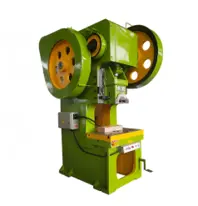
A mechanical punch press machine uses a flywheel, clutch and crankshaft to deliver a fixed stroke at high speed. It is the workhorse of sheet metal punching: 10 to 200 ton, 30 to 120 strokes per minute, lowest cost per hole. Because the stroke is fixed, the mechanical punch press machine is ideal for repetitive work with a dedicated die, and less suitable when you need to hold pressure at the bottom of the stroke.
Hydraulic punch press machine
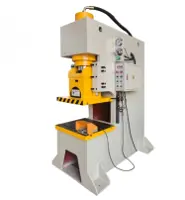
A hydraulic punch press machine generates force with an oil pump and cylinder, so tonnage and stroke can be set and held. It is the right choice for thick plate, deep drawing, busbar punching and any job where the ram must dwell under pressure. A hydraulic punch press machine costs more than a mechanical one of the same tonnage and is slower, but it protects the tooling better and allows full-tonnage work at any point of the stroke.
Pneumatic punch press machine
A pneumatic punch press machine uses compressed air and is normally a small, bench-mounted unit of 0.5 to 5 ton for eyelets, grommets, terminals, small brackets and light assembly work. It is fast, clean and cheap to install, but it cannot replace a flywheel press for continuous heavy punching.
CNC turret punch press machine
A CNC punch press machine stores dozens of tools in a rotating turret and positions the sheet under numerical control, so a whole program of holes runs without manual tool changes. Turret punch press machines are the standard for mixed, small and medium batches in panel building and enclosure manufacturing. Programming skill matters more than tonnage here.
Servo, high speed and special configurations
A servo punch press machine replaces the flywheel with a servo motor, giving programmable stroke, quiet operation and lower energy use. A high speed punch press machine with a roll feeder and straightener is used for lamination, connector and terminal strip production, where 200 to 800 strokes per minute are normal. A deep throat punch press machine (also called a C-frame or deep throat press) gives 500 to 1500 mm of throat depth for punching inside large panels and profiles that cannot be turned on a standard bolster.
Small, mini, desktop and manual versions
A small punch press machine of 1 to 10 ton, a mini or miniature punch press machine of 0.5 to 2 ton and a desktop or benchtop punch press machine of 0.5 to 1 ton all serve workshops that punch small parts, washers, tags, badges or jewellery components. A manual punch press machine or hand punch press machine — lever, rack or screw driven — has no motor at all and is used where volume is low or no power is available; the foot operated electric version is the usual compromise for eyelets and grommets. Many buyers search for a DIY punch press machine, and we say the same thing every time: building the frame is easy, building a guided die set that survives 50,000 strokes is not. Above this range, an automatic punch press machine with feeder and unloader is the entry point to unattended production. Motors are available in 380 V three-phase or 220 V / 110 V single-phase for workshop and export markets.
● 4. How to select the right punch press machine tonnage
Tonnage is the single most important specification. Undersized, the press stalls, deflects and eventually cracks; oversized, you pay for capacity you never use and lose rigidity in the tooling.
The tonnage formula
Required force (kN) = cut length (mm) × sheet thickness (mm) × shear strength (MPa) ÷ 1000. Then divide by 9.81 to get metric tons, and add 20 percent as a safety margin for wear, tool sharpness and material variation.
Worked example. A 200 mm perimeter cut in 3 mm cold-rolled steel (shear strength about 350 MPa): 200 × 3 × 350 ÷ 1000 = 210 kN, which is about 21 ton. With a 20 percent margin you need a 25 ton punch press machine — which is exactly why 25 ton is the most common size sold to job shops.
Tonnage guide by application
| Tonnage | Typical work | Typical drive |
|---|---|---|
| 1–5 ton | Eyelets, grommets, terminals, badges, sequins, small washers | Pneumatic, manual, bench press |
| 6–10 ton | Thin sheet brackets, tags, small covers, number plates | Mechanical, small C-frame |
| 16–25 ton | General job-shop punching up to 3 mm, electrical enclosures | Mechanical, deep throat |
| 30–40 ton | 4 mm sheet, busbar up to 60 × 10 mm, junction boxes | Mechanical or hydraulic |
| 63–80 ton | 6 mm plate, notching, louvers, forming with pressure dwell | Mechanical or hydraulic |
| 100–200 ton | Heavy plate, large blanks, progressive dies, high volume | Mechanical, hydraulic, high speed |
Prices for each size are listed in section 11, model by model. Tooling, feeder, guarding, voltage and freight change the final quotation, so we quote every punch press machine against a written specification rather than against a catalogue photo.
● 5. Mechanical vs hydraulic vs pneumatic: which one should you buy?
Choose mechanical for speed and cost per part, hydraulic for force control and thick material, pneumatic for small light work. The comparison below is the one we use with customers who are still undecided.
| Criterion | Mechanical punch press | Hydraulic punch press | Pneumatic punch press |
|---|---|---|---|
| Force at bottom of stroke | Fixed, peaks at bottom dead centre | Full tonnage anywhere in the stroke | Low, 0.5–5 ton |
| Speed | High, 30–120 strokes/min | Medium, 10–40 strokes/min | High, short stroke |
| Thick plate and drawing | Limited | Best choice | Not suitable |
| Tool protection | Needs overload release and brake monitor | Pressure relief protects the die | Naturally limited force |
| Investment | Lowest | 30–60% higher | Lowest of all |
| Maintenance profile | Clutch, brake, flywheel bearings | Oil, seals, valves, filtration | Air quality, seals, cylinders |
| Best for | Repetitive thin sheet, high volume | Thick plate, busbar, deep forming | Eyelets, terminals, assembly |
● 6. What you can make: applications
A die punch press machine is only as useful as the tooling in it, but the range of products is wide. Typical jobs we quote every week:
- Sheet metal work: brackets, covers, chassis, panels, louvers, washers, clips, hinges, mesh and perforated plate.
- Electrical: busbar punching and notching (copper and aluminium up to 12 mm), multi-station busbar punching on a single stroke, junction box knockouts, DIN rail slots, terminal strips, cable tray segments.
- Signage and identification: vehicle number plates, license plates, badges, tags, stencils, arc and wheel shapes for decorative panels.
- Small metal goods: eyelets, grommets, sequins, jewellery blanks, zipper parts, filter caps, bottle caps and closures.
- Automotive and appliance: brackets, reinforcement plates, heat shields, motor laminations and progressive-die parts.
Aluminium cutting (aluminum, in US spelling) is a frequent request: a punch press machine handles aluminium sheet and profile well provided you use polished tooling, a positive rake and adequate stripping force, because soft aluminium tends to stick to the punch face.
Two other configurations are worth knowing: a combination shear, roll and punch press machine (ironworker type) does several operations on one frame for maintenance workshops, and an indexing punch press machine rotates the tool or the part between strokes for radial hole patterns such as flanges and wheel discs.
● 7. Main parts, wear parts and HS codes
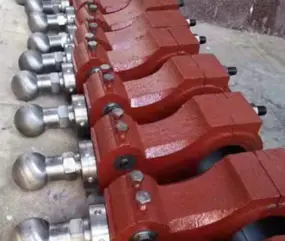
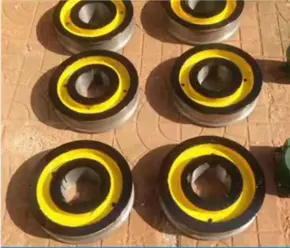
The frame, crankshaft, connecting rod, flywheel, clutch and brake determine the life of the machine; the die set, punch, stripper and guides determine the quality of the part. Wear parts are cheap, but only if you can identify them — which is why every machine ships with a numbered parts list.
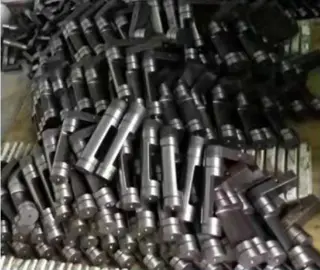
Drive train: crankshaft, connecting rod, flywheel, brake
The crankshaft converts rotation into reciprocating motion; the connecting rod links it to the ram; the flywheel stores the energy released in one stroke; the clutch engages the stroke and the brake stops it. On a mechanical punch press machine, the brake and clutch are the parts that need inspection most often, together with the flywheel bearings and the lubrication circuit.
Tooling: die set, punch, stripper, die shoe
A die set consists of the punch, the die plate, the stripper plate, guide pins and the die shoe. Clearance between punch and die is normally 5 to 8 percent of sheet thickness per side for steel; too little clearance causes pick-up and tool breakage, too much causes burrs and roll-over.
Flywheel, ram, bolster and feeder
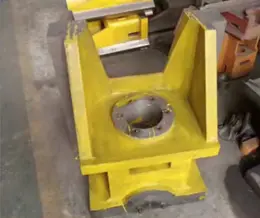
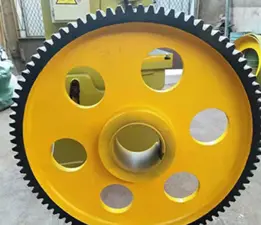
The flywheel of a punch press machine stores kinetic energy; the ram carries the punch; the bolster supports the die; the feeder advances the strip. On automatic configurations a roll feeder, straightener and scrap cutter complete the line.
HS codes for the machine and its parts
Most punch press machines are declared under HS 8462.10 (die-stamping and punching machines) or, depending on configuration, 8462.41 / 8462.49 for shearing-type presses. Parts follow their own headings. Always confirm the code with your customs broker before shipment: the tariff decides the duty, and a wrong code delays clearance.
| Item | Indicative HS code | Notes |
|---|---|---|
| Punch press machine (complete) | 8462.10 / 8462.41 / 8462.49 | Depends on drive and function |
| Punch and die for tablet or metal press | 8207.30 | Interchangeable tools for pressing |
| Flywheel and gear assemblies | 8483.40 | Gears, flywheels and pulleys |
| Crankshaft and connecting rod | 8483.10 | Transmission shafts and cranks |
| Welded frame and structural parts | 7308.90 | Structures and parts of iron or steel |
| Clutch, brake and control valves | 8483.90 / 8481.20 | Parts and hydraulic valves |
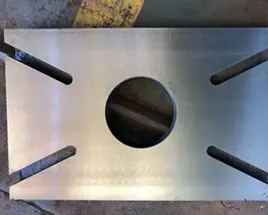
● 8. Working principle: what happens in one stroke
One stroke of a punch press machine has four phases: flywheel energy is released through the clutch, the crankshaft pushes the ram down, the punch shears the sheet against the die, and the stripper pulls the sheet off the punch while the brake stops the ram at top dead centre. Understanding the sequence explains most quality problems.
Force, deflection and rigidity
A press frame deflects under load. On a C-frame machine the throat opens slightly at full tonnage, which is why deep throat presses are rated more conservatively and why the die must be guided by pillars rather than by the press ram alone. A closed-frame (H-frame) punch press machine is stiffer and preferred for progressive dies and tight flatness.
Stripping, slug removal and jamming
If stripping force is too low the sheet climbs with the punch; if the slug cannot fall freely it stacks in the die and eventually breaks the punch. Both faults are visible in the first hundred parts, and both are solved with correct spring pressure and a slug relief hole — not with more tonnage.
Where a diagram helps
Ask any supplier for the punch press machine diagram of your exact model before you approve the order: the stroke, shut height, bolster size and throat depth on the drawing are what the die designer needs. A generic catalogue picture is not enough to build tooling.
● 9. Safety and guarding
A punch press machine is one of the most dangerous machines in a workshop because the hazard is a closing point at hand height, cycling up to twice per second. Guarding is not an accessory; it is part of the machine specification.
- Fixed guarding around the flywheel, belt drive and the back of the ram.
- Point-of-operation protection: two-hand control, light curtain, or a fixed barrier with an aperture that keeps hands out of the die area.
- Brake monitoring on mechanical presses: the brake must stop the ram within the rated stopping time, and that time must be checked at every shift change.
- Lockout during die change: disconnect and lock the main switch before any tool is installed or adjusted.
- Training: the operator must be trained on the specific machine and die, not on presses in general.
We supply machines with guarding, two-hand control and a brake monitor as standard on request, and we recommend a daily check of the safety devices before the first stroke — the same check that appears in the operating manual.
● 10. How to operate and maintain a punch press machine
Most punch press failures are lubrication and adjustment failures, not metal fatigue. The routine below is the one we put in every manual.
Before work
Check lubrication at every point and top up; confirm the die is correctly seated and clamped; test the switches and the safety devices with the flywheel disengaged; run the ram through several idle strokes and listen for abnormal noise; check that the flywheel rotates in the direction of the arrow; grease the ram guides with a manual pump.
During work
Top up lubrication at the stated intervals, never punch two sheets at once, never let an untrained operator adjust the machine, and stop immediately on any abnormal sound, vibration or temperature rise. A punch press machine that starts to sound different is telling you something.
After work and periodic checks
Clean the machine, oil the bolster surface against rust and record the day's production and any anomaly. Weekly: check clutch and brake adjustment, bolster bolts, guide clearances. Monthly: inspect the lubrication circuit, the flywheel bearings and the electrical cabinet. Annually: check frame bolts, replace worn seals and verify the brake stopping time with an instrument.
● 11. Price and cost breakdown: what drives the price of a punch press machine
The price of a punch press machine is set by tonnage, frame type, drive, throat depth, stroke, speed, control system and guarding — not by the brand plate. Two machines of the same tonnage can differ by 40 percent because one is a welded C-frame with a mechanical clutch and the other a stress-relieved H-frame with a wet clutch and servo feed.
Punch press machine price list (standard configuration, FOB China)
| Model | Nominal force | Price (USD) | Typical use |
|---|---|---|---|
| 10 ton punch press | 10 t | 600 | Tags, washers, thin brackets, number plates |
| 16 ton punch press | 16 t | 1,400 | Small brackets, covers, 1–2 mm sheet |
| 25 ton punch press | 25 t | 2,500 | General job-shop work up to 3 mm |
| 40 ton punch press | 40 t | 3,500 | 4 mm sheet, junction boxes, small busbar |
| 63 ton punch press | 63 t | 3,800 | 5 mm sheet, notching, forming |
| 80 ton mechanical punch press | 80 t | 7,500 | 6 mm plate, louvers, progressive work |
| 100 ton mechanical punch press | 100 t | 9,000 | 8 mm plate, large blanks |
| 200 ton punch press | 200 t | 12,000 | Heavy plate, large dies, high volume |
These are the machine prices only, for the standard configuration and standard voltage. Dies, feeders, special throat depths, guarding packages, packing and freight are quoted separately, because they depend on the part you want to produce.
- Machine (60–70% of the project): tonnage, frame, drive, control.
- Tooling (10–25%): a simple single-station die is cheap; a progressive die with several stations can cost as much as the press.
- Automation (5–15%): feeder, plate feeding and coil straightener, scrap cutter, unloader.
- Logistics and duties (5–15%): a 25 ton press is a heavy, tall crate; sea freight, insurance and inland transport are real numbers.
- Installation and training (2–5%): foundation, levelling, power connection, operator training.
When you compare quotations, compare the total cost per good part over five years, not the FOB price. A cheaper machine with a weaker frame and no brake monitor costs more the first time it is overloaded.
● 12. Buying a punch press machine from China: factory checklist
China supplies a large share of the world's mechanical presses, and punch press machine companies range from small assembly workshops to integrated factories that cast, weld, machine and test in one plant. The difference between a good and a bad purchase is not the country, it is the specification and the inspection.
New or used?
A used punch press machine can be excellent value if the frame is sound and the clutch and brake are serviceable; it is a trap if the crankshaft has been welded or the ram guides are worn beyond adjustment. Ask for run-out measurements, a video of the machine running under load, and the maintenance history. For most buyers importing for the first time, a new machine with a warranty is the lower-risk route.
Questions to ask every supplier
- What is the exact tonnage, stroke, shut height, throat depth and bolster size — on a drawing, not in a table?
- What steel is the frame and the crankshaft, and is the frame stress-relieved after welding?
- Which clutch and brake type, and is a brake monitor included?
- What guarding and point-of-operation protection are supplied?
- What is the voltage, phase and frequency of the motor, and is a transformer needed?
- Which spare parts ship with the machine, and what is the lead time for wear parts?
- Can you run my part or my die before shipment, and send the video?
- What is the HS code you declare, and what packing and lifting points do you use?
As a manufacturer we answer these in writing before the proforma invoice, and we test every punch press machine under load with the customer's die when one is supplied. If a supplier cannot answer question 1 with a drawing, the rest of the answers do not matter.
Wholesale, distributors and OEM
For distributors, importers and brands buying in volume, we build under your brand, supply the manual and nameplate in your language, and ship consolidated containers with mixed tonnages. Wholesale pricing starts at three units per order.
● 13. Frequently asked questions
What does a punch press machine do?
It punches, pierces, notches, blanks, bends and forms sheet metal by pressing a punch into a die. The die determines the shape; the press supplies force and stroke.
What are the different types of punch press machine?
Mechanical (flywheel and clutch), hydraulic, pneumatic, servo, and CNC turret punch presses, plus manual, bench, deep throat and high speed variants. Mechanical covers most thin-sheet work; hydraulic covers thick plate and forming.
How do I calculate the tonnage I need?
Cut length in mm × thickness in mm × shear strength in MPa ÷ 1000 gives kilonewtons; divide by 9.81 for tons and add 20 percent. A 200 mm cut in 3 mm steel needs about 25 ton.
What is the price of a punch press machine?
From about USD 1,500 for a 10 ton mechanical machine to USD 60,000 for a 200 ton hydraulic press, FOB China, before tooling and freight. The tonnage and the die are the two biggest cost drivers.
What is the HS code for a punch press machine?
Normally 8462.10 for die-stamping and punching machines, or 8462.41 / 8462.49 for shearing-type presses. Parts such as dies, flywheels and crankshafts have their own codes.
Can a punch press machine cut aluminium and stainless steel?
Yes, with the right tooling and clearance: polished punch faces and a positive rake for aluminium, higher tonnage and slower speed for stainless steel.
How thick can a punch press machine punch?
It depends on tonnage and die size rather than on the machine alone: a 25 ton press punches 3 mm steel over a short perimeter, a 100 ton press handles 8 to 10 mm plate with a suitable die.
What maintenance does a punch press machine need?
Daily lubrication and safety checks, weekly clutch and brake adjustment checks, monthly inspection of the lubrication circuit and bearings, and an annual brake stopping-time verification.
Do you provide the manual and the electrical diagram?
Yes. Every machine ships with the operating manual, the hydraulic and electrical diagrams, the parts list and a video of the acceptance test.
How long is delivery?
Standard mechanical models take 20 to 35 days from deposit; hydraulic and custom configurations take 35 to 60 days. We confirm the date in the proforma invoice.
● 14. Talk to us about your punching job
Send us the drawing or a photo of the part, the material, the thickness and the monthly quantity, and we will recommend the tonnage, the die concept and the machine configuration — then quote a punch press machine price against that specification. Ask for the full catalogue and the specification sheet as a PDF, with the drawings for your tonnage, and we will send them the same day. We answer technical questions in English, Spanish and French.
Chongqing Fychis Machinery Co.,Ltd (FYCHIS)
Address: No. 7-75, Middle Section of Daxuecheng Road, Huxi Street, High-tech Zone, Chongqing, China
Email: 877657530@qq.com
WhatsApp: +86 191 1290 5173 /
Punching press machine for sale · Sheet metal punch press machine · Mechanical punch press machine 80 ton · Punch press machine for sale 40 ton
