



40 Ton Punch Press Machine For Sale
Punch press machine capacity: 40 ton
Punch press machine price: 3,500 USD FOB China
This 40 ton punch press machine for sale is the size most workshops buy after they outgrow a 25 ton press: it punches 4 mm mild steel with a 56 × 56 mm square hole, or 6 mm steel with a small hole, and it still runs on a standard 380 V three-phase supply. The price of the machine in standard configuration is 3,500 USD FOB China, and it is the fourth line of our punch press machine price list.
Below you will find the punching capacity of the 40 ton model, the complete price list of every size we build, the configuration we deliver, the parts that wear, and the checks we recommend before you sign a purchase order — new or used.

● 1. What a 40 ton punch press machine can punch
A 40 ton press punches 4 mm mild steel up to about 224 mm of cutting perimeter, which is a 56 × 56 mm square hole, or 3 mm steel up to 299 mm, which is a 74 × 74 mm square. That single difference — one extra millimetre of thickness at a useful hole size — is why the 40 ton model sells more than any other size to electrical enclosure and busbar workshops.
Capacity by material thickness
We calculate every job with the standard formula and keep 20 percent of the tonnage in reserve:
Force (kN) = perimeter (mm) × thickness (mm) × shear strength (N/mm²) ÷ 1000. Mild steel ≈ 350 N/mm², stainless ≈ 500 N/mm², aluminium ≈ 200 N/mm². Nominal 40 ton = 392 kN, so we plan jobs at 314 kN maximum.
| Material thickness | Max cutting perimeter at 40 t (80% rule) | Typical shape it allows |
|---|---|---|
| 1.0 mm | 897 mm | 300 × 150 mm cut-out |
| 2.0 mm | 448 mm | 112 × 112 mm square, or Ø142 mm round |
| 3.0 mm | 299 mm | 74 × 74 mm square, or Ø95 mm round |
| 4.0 mm | 224 mm | 56 × 56 mm square, or Ø71 mm round |
| 5.0 mm | 179 mm | 44 × 44 mm square |
| 6.0 mm | 149 mm | 37 × 37 mm square |
| 8.0 mm | 112 mm | Small holes only — consider the 80 ton model |
Throat depth is the second limit. On the 40 ton C-frame the workpiece can be pushed into the throat to reach the die centre; for long profiles such as busbar or cable tray, ask us for the deep throat version, because a standard throat will stop you after the first 200 mm of the part.
● 2. Punch press machine price list: all sizes, one table
These are the machine prices we quote every day, in standard configuration and standard voltage, FOB China. They are the same numbers our sales team works from, published here so you can budget before you send an enquiry.
Published price list, 10 to 200 tons
| Model | Nominal force | Price (USD) | Typical use |
|---|---|---|---|
| 10 ton punch press | 10 t | 600 | Tags, washers, thin brackets, number plates |
| 16 ton punch press | 16 t | 1,400 | Small brackets, covers, 1–2 mm sheet |
| 25 ton punch press (JB23-25) | 25 t | 2,500 | General job-shop work up to 3 mm |
| 40 ton punch press (this page) | 40 t | 3,500 | 4 mm sheet, junction boxes, small busbar |
| 63 ton punch press | 63 t | 3,800 | 5 mm sheet, notching, forming |
| 80 ton mechanical punch press | 80 t | 7,500 | 6 mm plate, louvers, progressive work |
| 100 ton mechanical punch press | 100 t | 9,000 | 8 mm plate, large blanks |
| 200 ton punch press | 200 t | 12,000 | Heavy plate, large dies, high volume |
Two warnings about this table. First, prices are for the machine only: dies, feeders, guarding packages, special voltage, packing and freight are quoted separately, because they depend on the part you want to produce. Second, the price is not linear with tonnage — the jump from 63 to 80 tons costs more than the jump from 40 to 63, because the frame, the clutch and the motor change class. If your work sits between two sizes, buy the larger one; a press run at 70 percent of its capacity lasts far longer than one run at 95 percent.
● 3. Standard configuration of the 40 ton press
Every 40 ton machine leaves the factory with the same base configuration. Anything outside this list is quoted as an option, in writing, before production.
Standard versus optional equipment
| Item | Standard | Optional |
|---|---|---|
| Frame | Welded, stress-relieved C-frame | H-frame, deep throat |
| Drive | Mechanical, flywheel, rigid clutch | Pneumatic clutch, variable speed |
| Control | Foot switch + two-hand buttons | PLC control, counter, batch programming |
| Motor | 380 V / 3 phase / 50 Hz | 220 V, 415 V, 440 V, 60 Hz |
| Guarding | Fixed front guard | Light curtain, interlocked enclosure |
| Lubrication | Manual pump, central points | Automatic lubrication |
| Tooling | Not included | Single-station, compound or progressive die |
| Documentation | Manual in English, exploded drawing | CE file, third-party inspection |
Ask for the data sheet of the exact machine you are buying and check four numbers: nominal force, stroke, strokes per minute and bolster size. Those four decide whether your die fits and whether the press is fast enough for your part. We send the data sheet with the quotation, not after the deposit.
● 4. Punch press machine parts and lubrication points
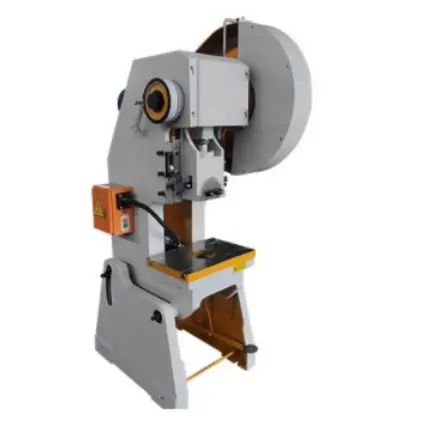
The 40 ton press uses the same mechanical architecture as every C-frame press: motor, flywheel, clutch, crankshaft, connecting rod, slide, guides, bolster and frame. The parts that decide reliability are the clutch, the brake and the lubrication of the connecting rod.
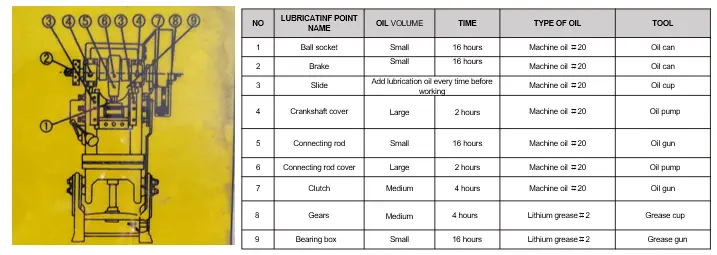
Lubrication points
The lubrication chart above is the one we print and stick on the machine. Grease the connecting rod big end and the crankshaft bearings every week; oil the slide guides every shift. A dry connecting rod bearing will score the crankshaft in a few hundred strokes under load, and that is a workshop repair, not a field repair.
Brake adjustment is the safety-critical item. Measure the stopping angle of the flywheel after every clutch adjustment: if the slide takes more than a quarter of a revolution to stop, the light curtain no longer guarantees protection and the brake must be re-set before the press goes back into production.
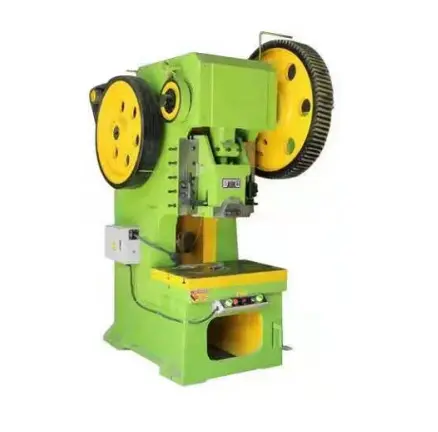
Punch press machine images: clutch, brake and slide
● 5. Why buy this 40 ton press from FYCHIS
Because you get the machine, the die and the test run from one supplier, and because the price on this page is the price we quote.
- One supplier for press and die. We design and build the tooling, so the die is tested on your press before packing and you receive a video of the test run.
- Real published prices. The 40 ton model is 3,500 USD, and every other size is on the list above. No "price on request" games.
- Voltage built to order. Latin America, Africa and the Middle East voltages are standard options, not special projects.
- Spare parts by part number. Every model ships with an exploded drawing, so a brake band or a bearing can be ordered years later without a photo of the broken part.
- Export experience. We have shipped presses to more than 40 countries, including Guatemala, Mexico, Peru, Colombia, Nigeria and the Philippines, with the packing and the documents that destination customs actually asks for.
● 6. New or used punch press machine: what to check
A used mechanical press can be an excellent buy, but only if four things are verified before payment. If the seller cannot show them, the price must drop accordingly.
- Frame cracks. Look at the throat radius and around the bolster bolts. A crack in the C-frame throat is the end of the machine; welding it changes the frame geometry and the die alignment.
- Crankshaft and connecting rod. Turn the flywheel by hand and feel for play at the bottom of the stroke. Any knock means bearing wear, and a scored crankshaft is an expensive part.
- Clutch and brake. Ask for the brake stopping time measured with an instrument, not by ear. On an old press this is the item that most often needs rebuilding.
- Table and slide surfaces. Deep gouges on the bolster mean the die was loose and the press was run out of alignment. Check the slide guides for scoring.
Compare the total: a used 40 ton press at 60 percent of the new price, plus a brake rebuild and a new die, often costs more than a new machine with a warranty and a tested die. Run the numbers before you decide.
● 7. Packing, delivery and payment
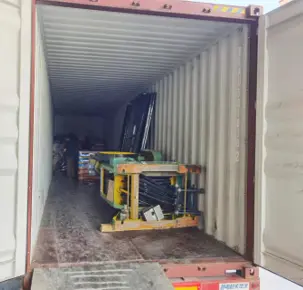
Mechanical presses ship in export wooden cases, with the slide blocked, the flywheel locked, the electrical box wrapped and the manual inside the case. A 40 ton C-frame press normally loads into a 20-foot container; larger sizes need a 40-foot or flat rack, and we confirm the loading plan before booking.
| Topic | What we do |
|---|---|
| Incoterm | EXW, FOB, CIF or DDP depending on destination |
| Packing | Export wooden case, rust-preventive oil, blocked slide, documents in a waterproof bag |
| Documents | Invoice, packing list, bill of lading, certificate of origin, CE file on request |
| Payment | 30% deposit and 70% before shipment by T/T; other terms discussed for repeat customers |
| Inspection | Video test run before packing; third-party inspection welcome at our factory |
Other names buyers use
Customers search for this machine as a punch press machine for sale, a metal punch press machine, a sheet metal punch press machine, a punch power press machine or a die punch press machine, and many start by looking at a used punch press machine. The names change, the requirement does not: 40 tons of force, a throat deep enough for the part, and a die that fits the bolster. Ask any punch press machine manufacturer for those three numbers in writing before comparing prices.
Still comparing sizes? The punch press machine buying guide puts the whole range from 10 to 200 tons side by side, with the tonnage table, the mechanical versus hydraulic comparison and the HS codes for import.
Factory, wholesale and buying guide
As a punch press machine manufacturer and supplier we quote from our own factory price list, and we sell wholesale to distributors as well as single machines to end users, with operator training material in English. We also build the hydraulic punch press machine range, the C-frame and the deep throat versions of this press, so we tell you honestly when a hydraulic machine is the better buy for your part. If you are unsure how to select punch press machine tonnage, send the drawing: the cost breakdown guide on this page is the same one we use in the quotation.
● 8. Frequently asked questions
What is the price of a 40 ton punch press machine?
3,500 USD FOB China in standard configuration. Dies, guarding upgrades, special voltage, freight and duties are quoted separately. Ask for a CIF price if you want the cost landed at your port.
How thick can a 40 ton press punch?
4 mm mild steel at a 224 mm perimeter (56 × 56 mm square), 6 mm at a 149 mm perimeter, and 8 mm only with small holes. Stainless steel reduces these figures by about 30 percent.
Should I buy the 40 ton or the 63 ton model?
If most of your work is 4 mm and below, the 40 ton is enough and costs 300 USD less. If you also notch, form or punch 5–6 mm plate regularly, the 63 ton model at 3,800 USD gives you the reserve that keeps the press and the die alive.
Does the price include a die?
No. A die is built from your part drawing, so it is quoted separately. Send the drawing with the enquiry and we quote machine plus tooling together, with the die tested on your press before shipment.
What voltage can you supply?
380 V three-phase 50 Hz as standard, and 220 V, 415 V, 440 V or 60 Hz on request. Confirm the voltage before production, because the motor and the electrical box are built to order.
What is the HS code for a 40 ton punch press?
8462.49 for a non-NC punching machine, 8462.41 for a numerically controlled one, and 8207.30 for the dies. Used presses are normally declared under 8462.49.
Can you help with installation?
Yes. We send a commissioning guide, a video call for the first start-up, and we can arrange an engineer visit for larger orders. The press needs a level floor and a 380 V supply; no special foundation is required for the 40 ton model.
What is the warranty?
12 months on mechanical parts, excluding wearing parts such as brake bands, seals and belts. Spare parts ship from stock against the part numbers in the exploded drawing.


