



25 Ton Punch Press Machine (JB23-25)
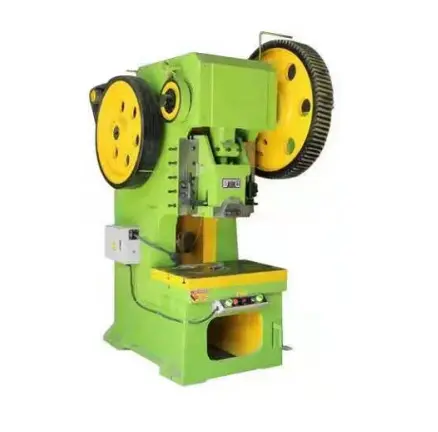
25 ton mechanical punch press machine, JB23-25 series
Punch press machine price: 2,500 USD FOB China
A 25 ton punch press machine is the smallest mechanical press that still does real production work: it punches up to 3 mm mild steel, sets rivets and eyelets, and runs at 70 strokes per minute on a 2.2 kW motor. Our JB23-25 sells for 2,500 USD in standard configuration, weighs 1,020 kg and fits in a 1,200 × 850 × 2,000 mm footprint, so it can be moved with a pallet truck and installed on a normal workshop floor without a special foundation.
This page gives you the real numbers: what the machine can punch, the full specification, the parts, the price breakdown, the guarding package and the maintenance schedule we recommend to every customer who buys a small punch press machine from us.
● 1. What can a 25 ton punch press machine punch?
A 25 ton press punches 3 mm mild steel up to roughly 186 mm of cutting perimeter, which is a 46 × 46 mm square hole or a 59 mm round hole. The limit is not the tonnage alone, it is tonnage divided by the perimeter of the hole you want, so a small hole in thick plate and a large hole in thin sheet can both be inside the capacity of the same machine.
Capacity by material thickness
We use the standard punching formula, with the 80 percent rule that keeps the press and the die out of overload:
Force (kN) = perimeter (mm) × thickness (mm) × shear strength (N/mm²) ÷ 1000, and we never plan a job above 80 percent of the nominal 25 tons (196 kN). For mild steel the shear strength is about 350 N/mm²; for stainless steel use 500 N/mm², for aluminium about 200 N/mm².
| Material thickness | Max cutting perimeter at 25 t (80% rule) | Typical shape it allows |
|---|---|---|
| 1.0 mm | 560 mm | 180 × 100 mm rectangular cut-out |
| 2.0 mm | 280 mm | 70 × 70 mm square, or Ø89 mm round |
| 3.0 mm | 186 mm | 46 × 46 mm square, or Ø59 mm round |
| 4.0 mm | 140 mm | 35 × 35 mm square, or Ø44 mm round |
| 5.0 mm | 112 mm | 28 × 28 mm square — near the limit, use a 40 t press instead |
Two mechanical limits matter as much as tonnage. The distance between the slide centre and the frame is 180 mm, so the workpiece can only be pushed 180 mm into the throat; parts wider than about 360 mm cannot be punched at the edge on this model. The bolster is 525 × 320 mm, which is the space you have for the die set.
● 2. Specification of the 25 ton mechanical punch press machine
Technical data of the JB23-25
The table below is the standard JB23-25 configuration we build. Stroke, die height and SPM can be changed on request, and every machine is tested with a die before it is packed.
| Parameter | Value |
|---|---|
| Nominal force | 25 ton |
| Nominal stroke | 70 mm |
| SPM (strokes per minute) | 70 |
| Die height adjustment | 50 mm |
| Between slide centre and frame (throat) | 180 mm |
| Bolster (table) | 525 × 320 mm |
| Blanking hole diameter | 160 mm |
| Main motor | 380 V three-phase, 2.2 kW |
| Outline dimension | 1,200 × 850 × 2,000 mm |
| Net weight | 1,020 kg |
Voltage is the point customers ask about most. 380 V three-phase 50 Hz is standard; we also build 220 V three-phase, 415 V, 440 V and 60 Hz versions for Latin America, the Middle East and Africa. Tell us the voltage and the plug type before we paint the machine, because the electrical box and the motor wiring are built to order.
● 3. Punch press machine parts of the JB23-25
The machine has eleven serviceable assemblies. Knowing them makes the spare-parts list and the daily inspection much easier, and it is the list our technicians use during the pre-delivery test.
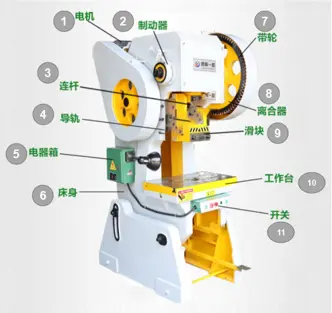
- Motor
- Brake
- Connecting rod
- Guide rail
- Electrical box
- Bed
- Wheels (for repositioning inside the workshop)
- Clutch
- Slider (ram)
- Workbench (bolster)
- Switch
The clutch and the brake are the two parts that decide the safety of a mechanical press. On the JB23-25 the clutch is a rigid mechanical type and the brake is a band brake; both must be adjusted together, because a brake that stops the slide too slowly leaves the operator's hands inside the die area longer than the guard design assumes.
● 4. Advantages of this small punch press machine
Four reasons customers choose the 25 ton size instead of a bigger press or a hydraulic alternative.
1. High power output for its size. The 2.2 kW motor drives a flywheel, so the press delivers 25 tons at the bottom of the stroke even though the continuous motor power is small. That is what makes a 1,020 kg machine able to cut 3 mm steel.
2. Strong stability. The frame is a welded, stress-relieved C-frame with a machined bed. A rigid frame keeps the die alignment after years of use, which is why the same JB23-25 body has been in production for decades.
3. Easy operation. One operator, a foot switch and two hand buttons. No programming, no CNC control to learn, no servo tuning. A new operator is productive on the first shift.
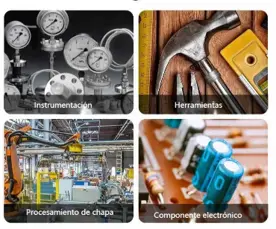
4. Versatility. With the right die the same press punches, notches, bends, embosses, sets rivets and eyelets, and assembles small components. Job shops use it for short runs of brackets, terminals, tags, washers, number plates and electrical covers.
● 5. Punch press machine price: what the 2,500 USD includes
2,500 USD is the FOB China price of the machine in standard configuration, and it is the same number you will find on our punch press machine price list for the 25 ton model. Here is what is inside that price and what is quoted separately.
Included: complete JB23-25 press, 2.2 kW motor wired for your voltage, mechanical clutch and brake, foot switch, standard set of tools and one manual in English, factory test with a die, export packing.
Not included: dies (quoted from your part drawing), light curtain or fixed guarding package if you need a higher safety level, feeder or uncoiler, sea freight, insurance, import duties, inland transport at destination.
Cost breakdown of a 25 ton project
| Cost line | Typical share of the project | Comment |
|---|---|---|
| Machine | 60–80% | 2,500 USD for the 25 ton model |
| Die / tooling | 10–25% | A simple single-station die is cheap; a compound or progressive die can approach the price of the press |
| Safety upgrade | 3–8% | Light curtain, two-hand control, enclosure |
| Freight and duties | 5–15% | Depends on destination port and Incoterm |
If you are comparing prices between suppliers, compare the same three things: clutch type, motor power and whether the price includes a test die. A 25 ton press with a lighter frame and a smaller motor can be sold cheaper, and it will show the difference the first time you punch 3 mm stainless.
● 6. Punch press machine guarding and safety
A mechanical press must never be operated without point-of-operation protection. We supply three levels of guarding, and we recommend at least a fixed guard plus a two-hand control for any press used in production.
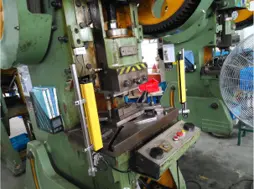
- Safety light grid: an emitter and a receiver across the die area. If a hand crosses the beam the slide stops before the dangerous phase. This is the fastest protection to retrofit and the one most customers choose.
- Fixed guard and safety door: a steel enclosure with an interlocked door. The press cannot cycle with the door open. Best for high-volume work where the operator loads from outside.
- Two-hand control: both buttons must be pressed within 0.5 seconds, so the operator cannot have a hand in the die. Combined with a foot switch lock-out for maintenance.
Also check the brake stopping time after any adjustment. If the slide takes longer to stop than the guard assumes, the light curtain no longer protects the operator, even if it works electrically.
● 7. How to operate the punch press machine
The sequence below is the one we teach during commissioning. It takes about ten minutes to learn and it is the same for every mechanical press of this size.
- Connect the press to the mains and turn the red main switch in the direction indicated by the arrow on the switch plate.
- Press the two green buttons with both hands to start the flywheel and bring the press into cycle-ready condition.
- Place the workpiece against the die location pin, then press the foot switch to make the stroke.
- Remove the finished part with pliers or a hook. Never put hands inside the die area to place or remove a part.
- Press the red stop button at the end of the run and cut the power supply.
- Clean the die area and the bolster, oil the lubrication points, and cover the machine.
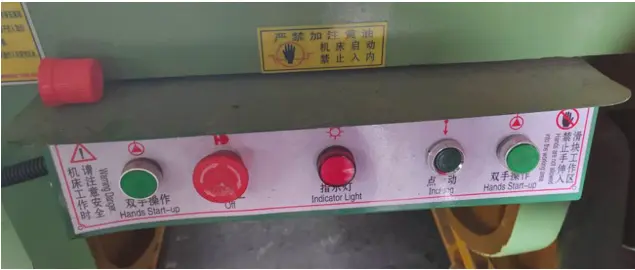
The video shows the same steps on the machine in our workshop. If you want the procedure in writing for your operators, we send a one-page SOP in English with every press.
● 8. Maintenance schedule for a 25 ton press
Mechanical presses fail for two reasons: lubrication and clutch adjustment. Both are cheap to control with a written schedule.
| Frequency | What to check |
|---|---|
| Every shift | Oil level, air pressure if a pneumatic feeder is used, unusual noise, foot switch cable, guard in place |
| Weekly | Lubricate the slide guides, connecting rod pins and crankshaft bearings; check clutch and brake adjustment; tighten bolster bolts |
| Monthly | Inspect the brake band wear, guide rail clearance, electrical box terminals and motor fan |
| Yearly | Change gearbox oil, check frame bolts, measure brake stopping time with an instrument, replace worn seals |
Lubrication points
The lubrication points of a mechanical punch press are the crankshaft bearings, the connecting rod big and small ends, the slide guides and the clutch. Missing the connecting rod is the most expensive mistake, because the bearing seizes and scores the crankshaft.
● 9. Our factory: who builds this punch press machine
FYCHIS has built mechanical presses since 2004 in Chongqing, China. We make the JB23 series from 10 to 100 tons, the JH21 pneumatic series, hydraulic presses and the dies that go with them, and we export to more than 40 countries. Every machine is assembled, run with a die and inspected before packing.

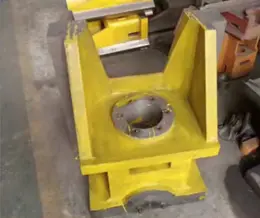
Because we also build the dies, we can quote machine and tooling together and test the die on the press before shipment. That removes the most common problem for a first-time buyer: a machine that arrives without a die that fits it.
Other names buyers use
This model is searched as a small punch press machine, a mini punch press machine, a press punch machine or a machine punch press, and job shops often call it simply a 25 ton press. If your work is lighter, the 10 ton and 16 ton models use the same frame family and the same tooling logic; if you need more throat or more force, move up to the 40 ton model. Whatever the name, the four numbers that decide the purchase are the same: nominal force, stroke, throat and bolster.
Still comparing sizes? The punch press machine buying guide puts the whole range from 10 to 200 tons side by side, with the tonnage table, the mechanical versus hydraulic comparison and the HS codes for import.
Factory, wholesale and buying guide
As a punch press machine manufacturer in Chongqing we build the machine rather than rebrand it, so the price on this page is the factory price, and we sell wholesale to distributors as well as single machines to workshops. If you are not sure how to select punch press machine tonnage, send the part drawing and we run the calculation with you. We also build hydraulic presses and pneumatic presses, and when the budget is tight we can offer a used punch press machine rebuilt and tested in our workshop. When you compare brands, compare frame weight, clutch type and whether a test die is included: that comparison is the real buying guide for a factory.
● 10. Frequently asked questions about the 25 ton punch press machine
What is the price of a 25 ton punch press machine?
2,500 USD FOB China for the standard JB23-25, which includes the press, the 2.2 kW motor, the foot switch and export packing. Dies, guarding upgrades, freight and duties are quoted separately, so ask for a CIF or DDP price if you want one number at your door.
How thick can a 25 ton punch press machine punch?
Up to 4 mm mild steel if the hole is small (about 140 mm of perimeter, for example a 35 × 35 mm square), and 3 mm mild steel for a 46 × 46 mm square. For stainless steel reduce the perimeter by about 30 percent because the shear strength is higher.
Is a 25 ton mechanical press strong enough for a job shop?
Yes for thin sheet work up to 3 mm: brackets, terminals, tags, washers, covers, number plates. If most of your work is 4 mm and above, or you need to hold force at mid-stroke for forming, go to the 40 ton or 63 ton model, or to a hydraulic press.
What voltage does the machine use?
380 V three-phase 50 Hz is standard. We build 220 V, 415 V, 440 V and 60 Hz versions on request at no extra cost for the motor; tell us the voltage before production starts.
What is the HS code for a punch press machine?
8462.49 for a non-NC punching machine, 8462.41 if it is numerically controlled, and 8207.30 for the dies. Used machines are also declared under 8462.49 in most countries.
Can you supply the die together with the press?
Yes. Send a drawing or a sample part and we quote the die with the machine, then test the die on your press before shipment and send you a video of the test run.
What is the warranty and the spare-parts support?
12 months on mechanical parts, with wearing parts such as brake bands and seals excluded. Spare parts are shipped from stock, and we keep the exploded drawing of every model so you can order by part number.


