



Mechanical Punch Press 16 Ton
Punching capacity: 16 ton mechanical punch press
Mechanical punch press price: 1,400 USD FOB China
A mechanical punch press is a stamping machine that stores energy in a flywheel and releases it through a clutch into one straight-line stroke, so a small motor can deliver a large force at the bottom of the stroke. This 16 ton model (160 kN, 130 strokes per minute, 2.2 kW motor) is the smallest press we build for production work, and it sells for 1,400 USD FOB China.
It is the right size for brackets, terminals, contacts, washers, small covers and hardware parts in material up to about 2 mm — the work that is too slow by hand and too small for a 40 or 63 ton frame. On this page: what it punches, the full specification, the parts and clutch that make it work, die selection, guarding, maintenance, price breakdown and how it compares with a hydraulic press.
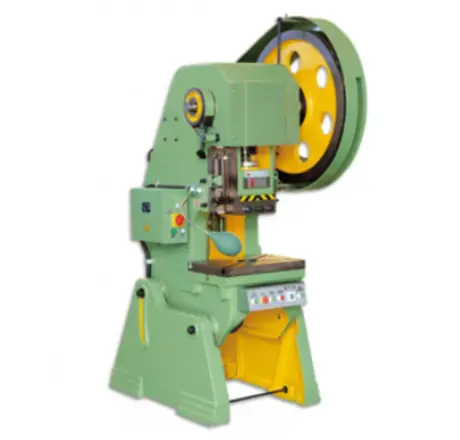
● 1. What a 16 ton mechanical punch press can punch
At 16 tons nominal, planning at 80 percent (128 kN), this press cuts 1 mm mild steel with 366 mm of cutting perimeter — a 90 × 90 mm square hole — or 2 mm steel with 183 mm, which is a 45 × 45 mm square. That covers the small-part work this class of press is bought for.
Capacity by material thickness
We size every job with the standard formula and the 80 percent rule, so neither the press nor the die runs into overload:
Force (kN) = perimeter (mm) × thickness (mm) × shear strength (N/mm²) ÷ 1000. Mild steel ≈ 350 N/mm², stainless ≈ 500 N/mm², aluminium ≈ 200 N/mm².
| Material thickness | Max cutting perimeter at 16 t (80% rule) | Typical shape it allows |
|---|---|---|
| 0.5 mm | 732 mm | Long slots and cut-outs in thin panels |
| 0.8 mm | 457 mm | 115 × 115 mm square, or Ø145 mm round |
| 1.0 mm | 366 mm | 90 × 90 mm square, or Ø116 mm round |
| 1.5 mm | 244 mm | 60 × 60 mm square, or Ø78 mm round |
| 2.0 mm | 183 mm | 45 × 45 mm square, or Ø58 mm round |
| 2.5 mm | 146 mm | 36 × 36 mm square |
| 3.0 mm | 122 mm | 30 × 30 mm square — small holes only |
| 4.0 mm | 91 mm | Single round hole up to Ø29 mm |
Two geometry limits matter as much as tonnage. The throat is 180 mm from slide centre to frame and the bolster is 290 × 460 mm, so this press is built for parts that fit in one hand, not for full sheets. If your blank is larger than about 360 mm across, look at the 25 or 40 ton models instead — the tonnage may be enough but the table and throat will not be.
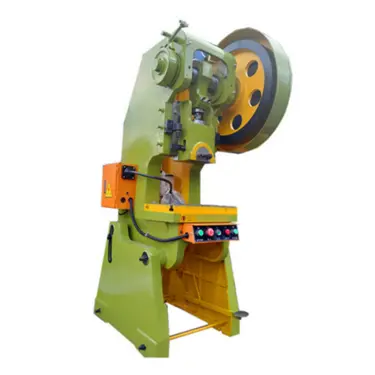
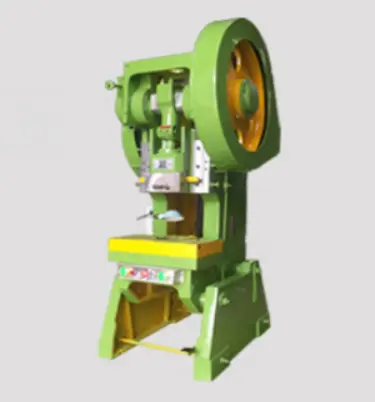
● 2. Specification of the 16 ton mechanical punch press
Technical data
The table below is the configuration we build and stock. Stroke, SPM and die height can be changed on request, and every press is run with a die before it is packed.
| Parameter | Value |
|---|---|
| Nominal force | 16 t (160 kN) |
| Nominal stroke | 60 mm |
| SPM (strokes per minute) | 130 |
| Die height adjustment | 40 mm |
| Between slide centre and frame (throat) | 180 mm |
| Bolster (table) | 290 × 460 mm |
| Blanking hole diameter | 160 mm |
| Main motor | 2.2 kW |
| Outline dimension | 1,020 × 800 × 1,900 mm |
| Net weight | 900 kg |
At 130 strokes per minute this is a fast press for its size: on a 1 mm bracket with a single-station die it will run all shift without the operator waiting on the machine. The 160 mm blanking hole lets slugs drop clear, and the 900 kg frame is light enough to sit on a normal workshop floor without a special foundation.
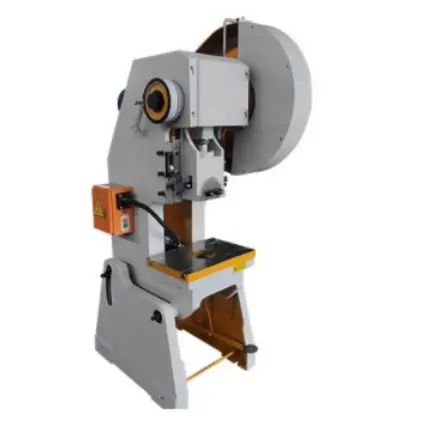
● 3. Characteristic of the mechanical punch press machine
These are the six design points that decide whether a small press stays accurate after a few years of work, and all six are standard on this machine.
- Transmission centre aligned with the frame centre. Force goes straight down the frame instead of twisting it, which is what keeps hole position stable over years of use.
- Two slider balancers. The slide runs balanced, so the press does not rock and the die does not take a side load.
- Highly sensitive clutch and brake with duplex electromagnet and overload protection. The slide stops where the signal says, which is the basis of every guarding system on the machine.
- Slide adjustment accurate to 0.1 mm. Die setting becomes a measured operation instead of a guess, and shut height stays repeatable between shifts.
- Crankshaft, gears and gear shafts hardened and ground. The friction parts are heat treated before grinding, which is why they keep their wear resistance instead of bedding in and going loose.
- Ready for automatic feeding. The press can be fitted with a coil feeder, a vibratory bowl or a rotary table, so one operator can run two or three machines.
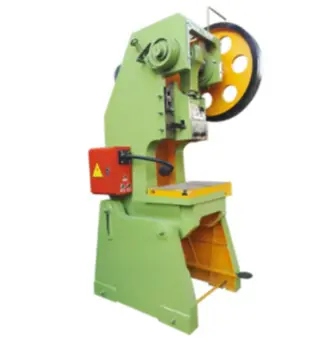
● 4. Mechanical punch press parts, design and clutch
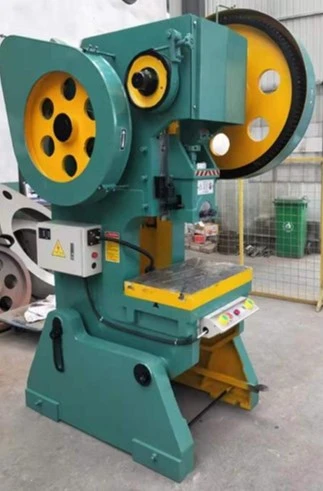
A mechanical clutch punch press has one job: turn the flywheel's rotation into one vertical stroke with full force at the bottom. Every part sits on that path, and every part is inspected before the machine is packed.
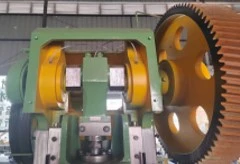
The force path
Motor → flywheel → clutch → crankshaft → connecting rod (pitman) → slide → die. The motor only has to keep the flywheel spinning; the flywheel stores the energy, and the clutch decides when that energy is released. That is why a 2.2 kW motor can deliver 16 tons: it delivers it for a few milliseconds per stroke, not continuously.
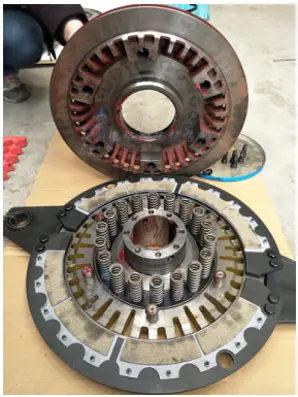
Mechanical clutch with dog pawl
This press uses a mechanical clutch with a dog pawl (also called a rolling-key clutch). A pawl engages a key into the flywheel for exactly one revolution, then releases. Three consequences for the buyer:
- One stroke per signal. The slide cannot repeat by itself, so a stuck foot switch does not produce a second stroke.
- Simple and repairable. No air supply is needed, and the wear parts — pawl, key, spring — are cheap and can be replaced in the workshop.
- Brake condition matters more. On a mechanical clutch the brake has to stop the slide within a fixed angle. A worn band brake silently lengthens stopping time, which is why we recommend a brake check every month.
● 5. Mechanical punch press die: which type to order
The die decides what the press can produce, and on a 16 ton machine it usually costs 20 to 35 percent of the whole project. Four types cover almost every job in this tonnage class.
| Die type | Features | Application scenarios |
|---|---|---|
| Single-operation piercing die | Piercing only, one stroke; simple structure and low cost | Small batches, one hole per stroke, prototype work |
| Compound die | Piercing and blanking in one stroke | Washers, contacts and gaskets where hole position must be exact to the outline |
| Progressive die | Strip-fed, multi-station continuous piercing and forming | Mass-produced terminals, brackets and electronic parts |
| Cam-driven side piercing die | Converts the vertical stroke into horizontal motion | Side-wall holes in bent and tubular parts |
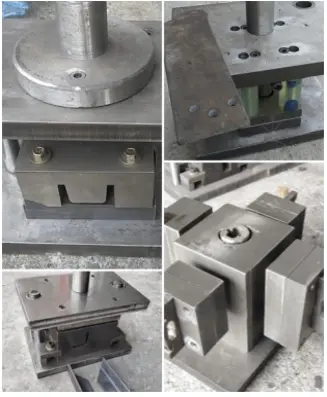
Three numbers decide whether a die fits this press: shut height, die height adjustment (40 mm here) and bolster size (290 × 460 mm). Send the die drawing and we confirm the fit before the machine is painted, not after it lands.
● 6. Mechanical punch press guarding and safety
Mechanical punch press safety is a system — guard, control and procedure — not one device bolted on at the end. At 130 strokes per minute the slide closes a 60 mm stroke twice per second, so every element has to work together.
The five controls we insist on
- Fixed guard around the die area, with an opening only for the workpiece.
- Light curtain or two-hand control on the operator side, wired so the clutch cannot engage while the beam is broken.
- Brake monitor: stops the press if stopping time drifts. This is the single most useful retrofit on a mechanical clutch press.
- Foot switch with guard ring, so a dropped part cannot be chased by a foot.
- Lockout before die change: flywheel stopped, main switch off, lock applied. Most press accidents happen during die setting, not during production.
If you export to the United States, OSHA 1910.217 is the reference your customer will audit against: it asks for point-of-operation guards, a brake monitor on mechanical power presses and documented periodic inspections. We supply the machine with a fixed guard and a guarded foot switch; light curtains and interlocked enclosures are quoted as options, because the right type depends on how the part is fed.
● 7. Mechanical punch press maintenance
A mechanical press fails in two places: the connecting rod bearing and the brake. Both are cheap to maintain and expensive to ignore, and both are covered by a schedule an operator can follow without a technician.
| Interval | Task | Why it matters |
|---|---|---|
| Every shift | Oil the guides, check the guard, test the brake stop, clear slugs | Dry guides and a lazy brake cause most repairs |
| Weekly | Grease the connecting rod big-end, check the clutch pawl and spring, inspect die fixings | The big-end bearing carries the full tonnage |
| Monthly | Check slide guide clearance, bolster T-slots, brake band wear, electrical terminals | Guide clearance sets die alignment |
| Yearly | Brake band and clutch key replacement, frame bolt torque, flywheel bearing | Brake wear is invisible until stopping time doubles |
● 8. Mechanical vs hydraulic punch press
Mechanical for punching and blanking, hydraulic for drawing and forming. The difference is where the force sits in the stroke: a mechanical press has full tonnage only near the bottom, a hydraulic press holds its force through the whole stroke.
| Mechanical punch press | Hydraulic punch press | |
|---|---|---|
| Force through the stroke | Full only near the bottom dead centre | Constant, adjustable, held as long as needed |
| Speed | Fast — 130 SPM on this 16 ton model | Slow, one cycle in seconds |
| Best work | Punching, blanking, notching, light bending | Deep drawing, thick-plate forming, shell pressing |
| Cost per part | Low | Higher on thin sheet, lower on deep draws |
| Footprint and price | Small and cheap at low tonnage | Larger and more expensive at the same tonnage |
● 9. Mechanical punch press price: what 1,400 USD includes
If you are comparing a mechanical punch press for sale at this size, 1,400 USD is the FOB China price of the 16 ton machine in standard configuration, and it matches the 16 ton line of our published punch press price list. Here is what sits inside that number and what is quoted separately.
Included: complete 16 ton press, 2.2 kW motor wound for your voltage, mechanical clutch with dog pawl, band brake, fixed guard, guarded foot switch, standard tool set, one manual in English, factory test with a die, export packing.
Not included: dies (quoted from the part drawing), light curtain or interlocked enclosure, coil feeder or vibratory bowl, special stroke or throat, sea freight, insurance, import duties, inland transport at destination.
| Cost line | Typical share | Comment |
|---|---|---|
| Press | 50–65% | 1,400 USD for the standard 16 ton machine |
| Die or progressive tool | 20–35% | A single-station die sits at the low end, a 3-station progressive at the high end |
| Feeder and automation | 5–15% | Coil feeder, vibratory bowl, scrap chute |
| Freight, packing and duties | 5–12% | 900 kg machine, LCL is usually cheaper than a container |
When two quotations for "the same" 16 ton press differ by 30 percent, the difference is almost always the die, the clutch type or the guarding package — not the frame.
● 10. Mechanical punch press manufacturer, factory and wholesale
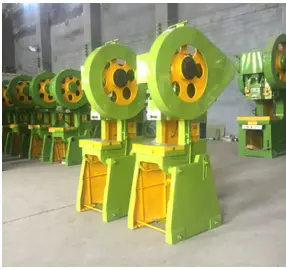
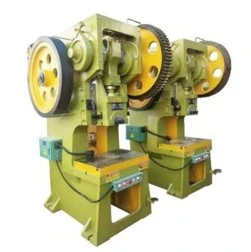
Most 16 ton presses look identical in a photo, because the design is decades old and widely copied. What separates suppliers is what is inside the frame and what arrives in the box.
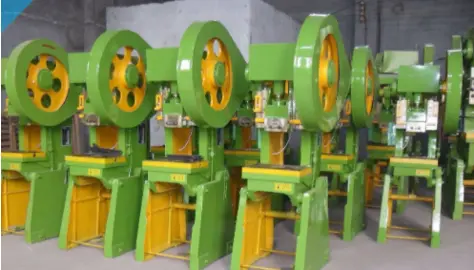
Six questions that separate real factories from traders
- Shipping weight. A 16 ton press that weighs 700 kg has less cast iron in it than one that weighs 900 kg. Ask for the weight in writing.
- Clutch type. Mechanical clutch with dog pawl, or pneumatic clutch with disc brake? They are different machines and the price gap is real.
- Test report. Ask for the test sheet with the die used and the stroke count. We run every press with a die before packing and send the photos.
- Spare parts list. A supplier who cannot name the bearing numbers is not building the machine.
- Voltage and plug. Confirm the motor winding and control voltage for your country before production, not after arrival.
- Who installs it. Commissioning guide and video call, or an engineer visit? Get it in the quotation.
We are a mechanical punch press manufacturer in Chongqing, not a trading company: the presses carry our own nameplate, and we sell wholesale to distributors as well as single machines to workshops. Used mechanical punch presses are also available on request — we inspect and re-test them the same way as a new machine, and we tell you the year and the hours before you commit.
● 11. Installation, shipping and after-sales service
The 16 ton press weighs 900 kg and needs no special foundation: a level concrete floor and four anchor bolts are enough. Installation is a half-day job with two people.
Installation steps
- Position the press with at least 800 mm clear on the operator side and room behind for slugs and scrap.
- Level the frame with shims under all four feet, then torque the anchor bolts. An unlevel press wears its guides on one side.
- Check the oil level and pull the lubrication pump until oil reaches the guides.
- Set the die using the 40 mm die height adjustment, then turn the flywheel by hand through one full revolution to confirm clearance.
- Run ten strokes without material, test the brake stop and the guard interlock, then run the first parts and check the burr height.
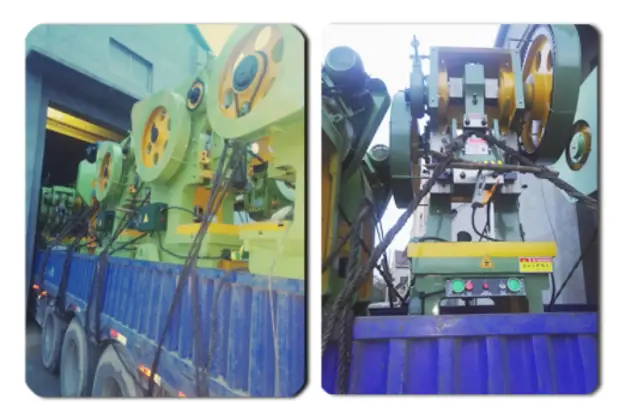
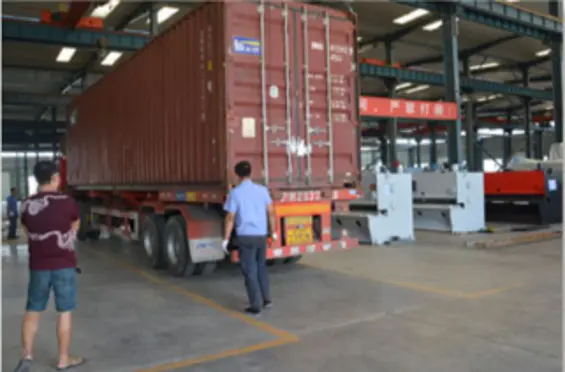
Every machine ships with an English manual, a commissioning guide and a spare-parts list. We support start-up by video call, and for larger orders we can arrange an engineer visit. Warranty is 12 months on mechanical parts; wear parts (brake band, clutch key, bearings) are supplied at cost afterwards.
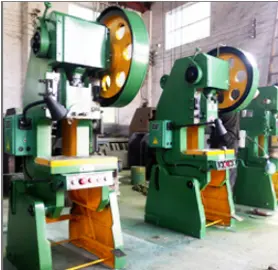
● 12. Mechanical punch press use: what customers produce
On a mechanical punching machine of this size, typical work is: electronic terminals and contacts, instrument parts, cold-cut saw components, small hardware and fasteners, toy and decoration parts, brackets, washers and small automotive clips.
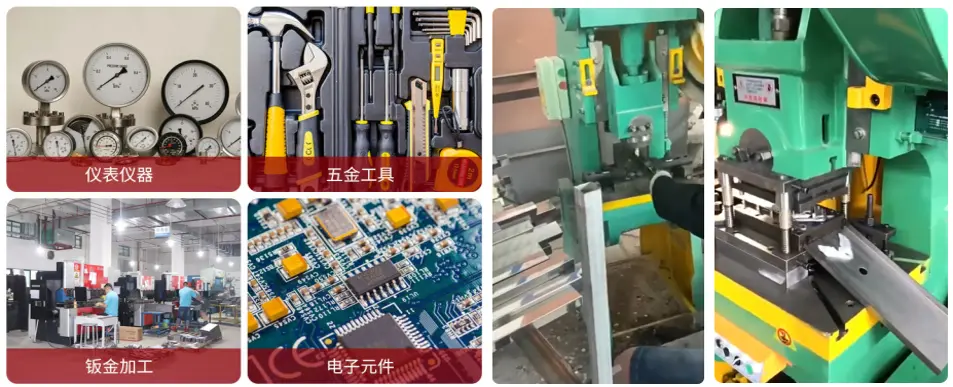
The mechanical punching process itself is simple: place the sheet on the lower die, locate it against the guide, step on the foot switch, and the upper die comes down. One stroke, one part. Compared with machining, punching saves material and time, and it produces features — burr-free edges, coined ribs, formed tabs — that a milling cutter cannot reach economically.
If your parts are mostly thin sheet in high volume, this is the cheapest machine that does the job properly. If the same part needs 3 mm or more in a large outline, move up to the 25 ton punch press machine or the 40 ton punch press.
● 13. Mechanical punch press terminology
Buyers and suppliers often use different words for the same part. These are the terms that appear in a quotation or a die drawing, with what they mean on this machine.
| Term | Meaning | On this press |
|---|---|---|
| Nominal force / tonnage | Maximum force at the bottom of the stroke | 16 t (160 kN) |
| Stroke | Distance the slide travels down | 60 mm |
| SPM | Strokes per minute | 130 |
| Shut height | Clearance between slide (up) and bolster | Set by the die height adjustment |
| Die height adjustment | Range for setting die height | 40 mm |
| Throat depth | Slide centre to frame — how wide a part can pass | 180 mm |
| Bolster | The table the lower die sits on | 290 × 460 mm |
| Blanking hole | Hole in the bolster for slugs to fall through | Ø160 mm |
| OBI | Open-back inclinable — C-frame that tilts back for part discharge | This frame type |
| Pitman | Connecting rod between crankshaft and slide | Carries the full tonnage |
| Stripper | Plate that holds the sheet down as the punch withdraws | Part of the die, not the press |
● 14. Frequently asked questions
Define mechanical punch press
A mechanical punch press is a stamping machine that converts the rotary motion of a motor and flywheel into a straight-line stroke through a clutch, crankshaft and connecting rod. The flywheel stores the energy, the clutch releases it once per stroke, and the die between the upper and lower platen cuts or forms the sheet. Before presses existed these operations were done by hand — slow, tiring and inconsistent.
Is this a 15 ton or a 16 ton press?
It is 16 tons nominal force, 160 kN. In the J23 family this size is sometimes listed as a 15 ton punch press by other suppliers; the frame, stroke and motor are the same machine, and our test sheet states 16 t. Ask any supplier for the nominal force in kN if the tonnage number looks rounded.
What is the price of a 16 ton mechanical punch press?
1,400 USD FOB China in standard configuration. Dies, light curtains, special voltage, freight and import duties are quoted separately, and a complete project with a single-station die usually lands between 1,900 and 2,400 USD before freight.
What is a mechanical clutch with dog pawl?
It is a clutch in which a pawl drives a key into the rotating flywheel for exactly one revolution, then releases. It gives one stroke per signal, needs no compressed air, and its wear parts are cheap and replaceable in the workshop. Its weak point is the brake: stopping time has to be checked monthly, because a worn band brake removes the protection the guard was designed around.
Mechanical or hydraulic punch press for my part?
If the part is flat, under 2 mm and produced in batches, a mechanical press: full force near the bottom of the stroke, 130 strokes per minute, low cost per part. If the part needs a deep draw or a thick plate formed, a hydraulic press, because it holds force through the whole stroke. A mechanical press cannot do a deep draw properly at any tonnage.
Can I use my existing die on this press?
Usually yes. Send the die drawing: we check shut height against the 40 mm die height adjustment, the shank size and the 290 × 460 mm bolster footprint before you order. A die built for a 25 ton press often fits, but a die with a larger shoe will not.
What safety devices are included?
A fixed guard around the die area, a guarded foot switch and a band brake as standard. Light curtains, two-hand control and interlocked enclosures are options quoted with the machine, because the right choice depends on how the part is fed. For the US market we quote against OSHA 1910.217 requirements on request.
How often does a mechanical punch press need maintenance?
Daily lubrication and a brake test, weekly grease on the connecting rod big-end and a clutch inspection, monthly guide clearance and brake band check, yearly brake band and clutch key replacement. On a single-shift operation that is about two hours of work per month.
Do you supply used or new mechanical punch presses?
Both. New machines are built to order in 15 to 25 days; used machines are inspected, re-tested with a die and sold with the year and running hours stated in writing. For wholesale orders we quote by container quantity.


